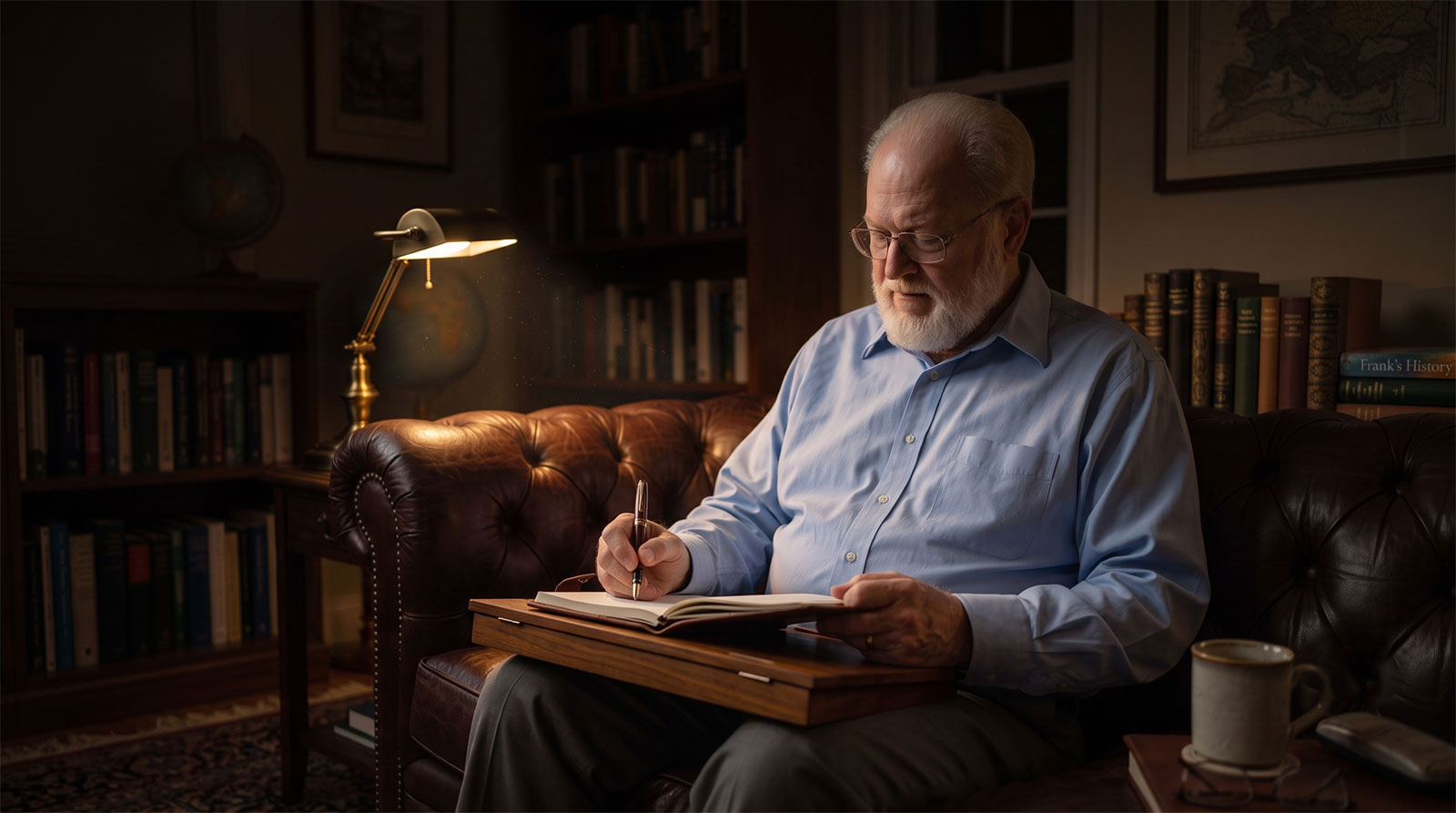
The quote library
Frankisms
Short truths, collected over a lifetime of writing and teaching. Read a few, or lose an afternoon.
- Collected
- 1,993
“Don’t get intimidated by someone else’s writing. — Jerry Cleaver”
writing
“Don’t say it was delightful; make us say delightful when we’ve read the description. You see, all those words (horrifying, wonderful, hideous, exquisite) are only like saying to your readers, Please, will you do the job for me? — C.S. Lewis”
writing
“Don’t tell the reader that the character is thinking—just have the character think it. — Cheryl St.John”
writing
“Don’t use nice, interesting, fun in your writing. It doesn’t say anything. — Natalie Goldberg”
writing
“Dramatically speaking, it is the tension of hanging on to the old as we are being pulled into the swift current of change that makes our stories alive and relevant. — Dara Marks”
writing
“Drop a stone in the still pool of your character’s life and watch the ripples. — Jeff Gerke”
writing
“Each character must serve a purpose, which is to rub another in a way that will reveal something meaningful about both of them. — Jerry Cleaver”
writing
“Even miracles are mundane happenings that an awakened mind can see in a fantastic way. — Natalie Goldberg”
writing
“Even someone as slothful as Larry or indolent as Karen can be a protagonist if you give them a problem they must solve—and then never, ever let up the pressure until they solve it or die trying. — Carole Bugge”
writing
“Even the longest book can capture only a tiny segment of any human being. — Dwight V. Swain”
writing
“Even the most seasoned writers have some resistance to sitting down to write. There are always other things we might have more fun doing. — Jane Anne Staw”
writing
“Even when you make up something, it’s important to know the real facts, because somebody out there probably knows more about your subject than you do. — Cheryl St.John”
writing
“Every day when you first wake up or before you begin working on your novel, you should do at least one exercise in your journal. — Sherri Szeman”
writing
“Every great story presents two levels of conflict for the reader’s pleasure: one, an external obstacle to the hero’s quest, and two, an internal demon that hinders the character’s ability to make the best possible decisions under pressure. — Larry Brooks”
writing
“Every novel has the same aim—to create an imaginary world and to draw the reader into it. When we write well, the reader prefers the imaginary world to the real world. — Ken Follett”
writing
“Every novel should, somewhere, at least make us crack a smile. — Donald Maass”
writing
“Every page of the story must have some type of stress that leads to conflict. — DiAnn Mills”
writing
“Every professional writer knows that this period of just sitting-and-thinking between legwork and outlines is the most important part of the whole writing process. It’s what makes a piece of writing what it is. — Rudolph Flesch”
writing
“Every scene has a viewpoint character stepping into action with a goal, a conflict, and a disaster. — DiAnn Mills”
writing
“Every scene in your novel should have tension in it, whether that comes from outright conflict or the inner turmoil of character emotions. — James Scott Bell”
writing
“Every step of the way, the reader must know why this particular situation is important and why he should care. — Cheryl St.John”
writing
“Everything in a story gets its meaning and emotional weight based on how it affects the protagonist in pursuit of her goal. — Lisa Cron, long-time consultant and agent”
writing
“Everything needs something by which to measure it in order to know how important it is. — Cheryl St.John”
writing
“Experience as much as you can lest your writing be shallow. — Dennis Hensley”
writing
“External actions are always driven by internal need. — Dara Marks”
writing
“Fiction reveals truths that reality obscures. — Jessamyn West”
writing
“Fiction takes the skeleton of historical fact and, without changing that structure, adds flesh, muscle, organs, and most of all, the breath of spirit. — Dayton Duncan”
writing
“Fiction, like the movies, is more fast-paced than it was twenty or thirty years ago. — Cheryl St.John”
writing
“Fill your paper with the breathings of your heart. — William Wordsworth”
writing
“Find short words that say what you mean. Delete the long words. People trip over them. — Joe Vitale”
writing
“Finding a copy editor who knows one kind of sentence from the other these days is becoming nothing short of miraculous. — Elizabeth George”
writing
“Flaws make a person human because we all have flaws. — Cheryl St.John”
writing
“For an idea to stick, for it to be useful and lasting, it’s got to make the audience: (1) Pay attention, (2) Understand and remember it, (3) Agree/Believe, (4) Care, (5) Be able to act on it. — Chip Heath”
writing
“For our idea to endure, we must generate interest and curiosity. — Chip Heath”
writing
“For some writers merely overcoming their initial anxiety about sitting down to write provides a force powerful enough to unravel anything else in their way. — Jane Anne Staw”
writing
“For the reader, beginning a new novel is like being teleported into some alternate dimension. It's going to take some time to look around, get his bearings, and then discern the lay of the land. — Jeff Gerke”
writing
“Forget trying to imitate any writer you admire. — Joe Vitale”
writing
“Frequently a great difference exists between the words you need in order to understand yourself and the words you need to make the same thought clear to someone else. — Theodore A. Rees Cheney”
writing
“From the very first sentence, the reader must want to know what happens next. — Lisa Cron”
writing
“Gather knowledge about the craft of writing. Immerse yourself in the art of it. Then write. Write yourself silly. — Elizabeth George”
writing