
Matthew 26:36–27:56; Mark 14:32–15:41; Luke 22:39–23:49; John 18:1–19:37
Why did Pilate yield to the cry of people whom he knew were unjustly prejudiced? Why was Simon from Cyrene forced to carry Jesus’ cross?
From the moment he left the upper room after the Last Supper, Jesus endured intense emotional, spiritual, and physical anguish without sleep. Strengthened by an angel and after a long time praying for total surrender to his Father’s will, we might expect him to have superhuman strength like Samson. Hypothetically, that could have been the case. Jesus could have summoned an army of angels, but since that wasn’t God’s plan, it couldn’t happen.
A look at what happened might tell us something about our journey as we take up our cross and follow him.
Betrayed with a Kiss
Sometime after midnight, Judas accompanied a small army of leading priests, members of the Sanhedrin, Temple guards, and others who wanted to see Jesus dead. They were a mob-like group carrying lanterns and torches, swords and clubs.
Apparently, Judas was returning from the mission he had received in the Upper Room, and he greeted Jesus with a kiss. After Jesus identified himself as the one they are looking for, the men drew back and fell to the ground. Yes, they came expecting to easily
overpower Jesus and a few disciples. Instead, they met the Son of God standing in full authority.
Still unaware that Judas was the betrayer, Peter cut off the high priest’s servant’s ear, using the sword he’d been told to bring. Jesus reprimanded him, making his message clear. This was not the kind of warfare that his disciples would fight.
No man would take Jesus’ life from him. This path of suffering unto death was God’s plan from the beginning. Jesus allowed himself to be arrested, bound, and led away into the night.
No Rest for the Weary
Jesus was dragged from one false trial after another, first before Annas, the former high priest. Most of the disciples had fled for their lives, but John went with Jesus, and Peter followed at a distance. Since Annas knew him, John was allowed to enter, and John spoke to a servant who allowed Peter to enter. For hours, perhaps, Annas asked many questions but received few answers.
From the house of Annas, Jesus was taken to the Temple for trial before the Sanhedrin and the high priest, Caiaphas. Prearranged witnesses were brought in, one after another, to testify against Jesus. For conviction, they needed only two or three witnesses to agree, but that wasn’t happening. In frustration, Caiaphas confronted Jesus directly, asking if he was the Son of God. In saying yes, Jesus did what the witnesses could not do. Jesus convicted himself. He was, in fact, the Son of God, who had willingly made himself subject to their judgment.
Jesus was much too popular with the people for the Jews to stone him to death like they later did to Stephen. He was delivered to Pilate, who sent him to Herod, who sent him back to Pilate. During that time, dragged by guards from one place to another, he was mocked, spat upon, and brutally beaten and bloodied. Without sleep and physically drained, he had only the strength of God’s presence to sustain him.
The Death Sentence
As Roman governor for five years, Pontius Pilate was well aware of Jesus’ popularity and why Jewish leaders wanted him dead. After talking with Jesus and learning that Jesus’ Kingdom was of a heavenly nature, without fighting or violence, he gave his official not-guilty verdict. But there was a problem. The crowd was in such an uproar that Pilate’s decision risked a rebellion that would call him back to Rome for his own judgment and death. Herod was no help, returning Jesus to him without a verdict.
Pilate then offered Jesus’ release as part of the Passover tradition, giving them the choice of having their popular servant set free, or they could have the notorious criminal Barabbas. Amazing. The people chose the criminal. Still hoping to set Jesus free, he ordered him flogged by Roman soldiers. Now with his purple robe and crown of thorns, surely the crowd would sympathize and want their king to live. But no, the leading priests wanted Jesus crucified, saying they had no king but Caesar.
Finally, Pilate washed his hands before the people, claiming not to be guilty of sending an innocent man to his death. Facing the choice of his own death in Rome if a rebellion followed, he reluctantly handed Jesus over to be crucified.
Free from Anxiety and Depression
Throughout his trials, torture, and sentencing, Jesus remained inwardly calm and spiritually steady. He had done nothing but help the people, condemning only the self-serving Pharisees and teachers of the Law. Entirely innocent of any crime, he never reacted out of anger or fear, demonstrating inner peace that might be difficult to explain. At one time or another, most people suffer from anxiety and depression over situations that either never happen or are much less severe.
Through all the suffering and facing a painful death on the cross, how could Jesus remain so calm? If we understand what he did, we can know what we must do to let go of our fears, frustrations, and worries. We can’t simply choose not to be afraid. First, we must learn why we have those feelings. They come from wanting to be in control but knowing we’re not. When Jesus in his humanity began his prayer at Gethsemane, he faced the same kinds of feelings. When he left, he was at peace.
Jesus’ victory is the same for us as we endure some form of pain and suffering. Loss of a job, death of a loved one, or a cancer diagnosis can be devastating. At some point, to be free from anxiety and depression, we must surrender our whole being to God and trust his control. This is not easy. Like Jesus, we need to pray a lot.
The Weight of the Cross
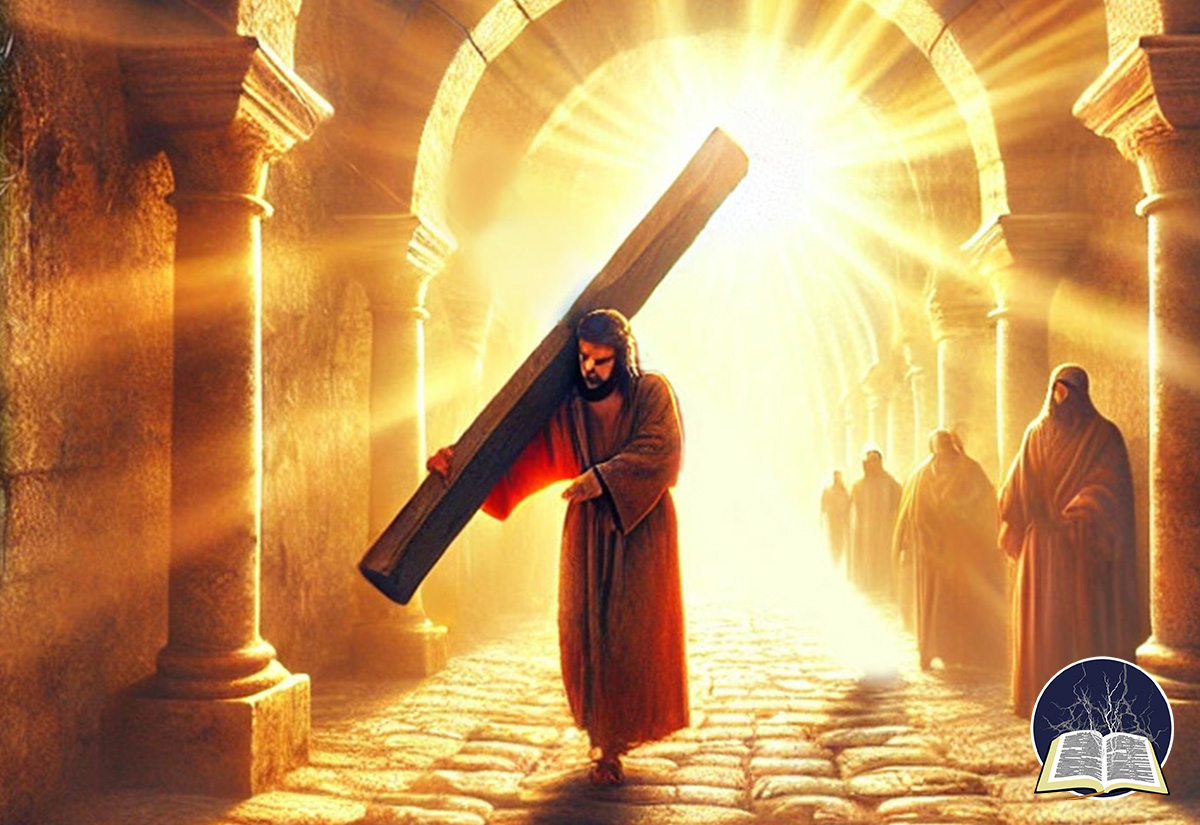
Most artists show Jesus carrying the entire cross on the way to Golgotha—both the vertical post and the crossbeam. The vertical beam weighed over 200 pounds and was kept permanently in a deep hole packed with stones around it so it wouldn’t wobble or fall. The fifty-pound crossbeam had a slot opening at the center. After the criminal’s arms were stretched and secured to the crossbeam, soldiers lifted the criminal and fit the beam over the protruding tongue atop the vertical post. The feet were then nailed or tied to the small wooden platform at just the right height so the criminal could live for as long as he could remain standing but would suffocate when he couldn’t.
These details are important for us to understand why Jesus was expected to carry his “cross,” the crossbeam weighing fifty pounds, not the entire cross weighing 250. A healthy man could carry the beam for the half mile to Golgotha, but Jesus barely had the strength to walk that far. The cross would have to be carried by someone else.
While prospering, a Christian might believe that God would never give us burdens more than we can bear, but in trying times, they may experience what they thought could never happen. They really did have more than they could bear. Yes, God will often either cause or allow unbearable burdens. Why? To show that we must rely upon others and trust him for strength to do his will.
In some way, we are all called to carry our cross and join Jesus on the road to redemption. Just like Simon of Cyrene, the cross we carry can lead us in our salvation walk and the day when we can say we’ve fought the good fight and have completed the work God had for us.
[Pontius Pilate] ordered Jesus to be crucified. On the way, the soldiers met Simon, a native of Cyrene, who had come from the country. They forced him to walk behind Jesus and carry his cross. — Luke 23:25–26 The Discussion Bible
For many more open-ended discussion questions for almost every verse in the Bible, check out The Discussion Bible