
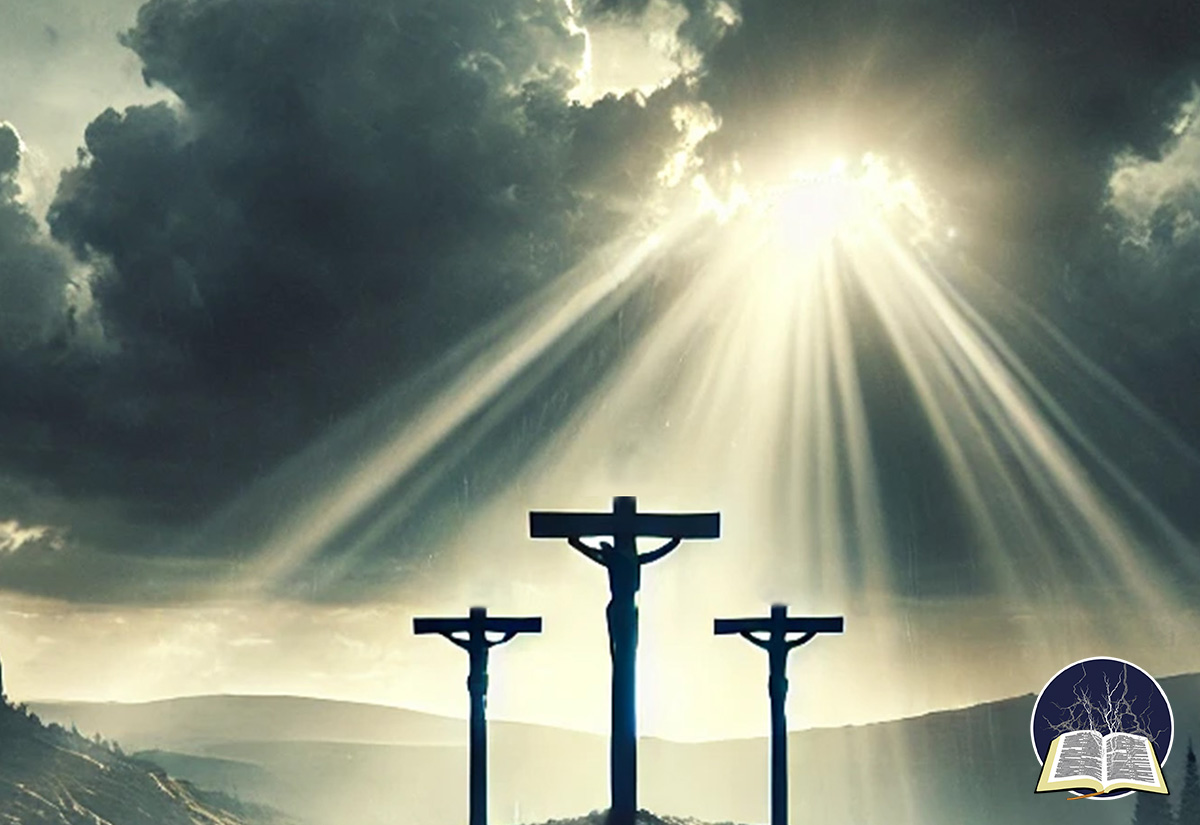
What did the criminals know about Jesus? What earned one criminal’s place in paradise?
Matthew 27:32–44; Mark 15:21–32; Luke 23:26–43; John 19:16–24
An emotionally charged crowd followed Jesus to the cross. Some were there to gloat, mock, and validate their role in condemning him before Pilate. Those who knew and loved him cried like they were losing their firstborn son or daughter. Others just happened to be walking by, curious but unaware that one who had healed the sick and raised the dead was among the thieves, about to die.
Public Execution
Crucifixions were public warnings against others even thinking about committing similar crimes. Each criminal had a sign above his head, describing what they had done to deserve death. We’re not told the nature of each person’s crime. For the men on each side of Jesus, the signs might have said: ROBBER, THIEF, BANDIT, or REBEL AGAINST ROME. Whatever their offense was, both men knew they were guilty and deserved their punishment.
Posted above Jesus’ head was KING OF THE JEWS. The Jewish leaders objected, saying Jesus’ crime was claiming to be king, not that he really was. Pilate refused to change the sign, leaving the crowd to consider its truth. Most of Jesus’ disciples were off hiding somewhere, but John was with the faithful women near the cross. Understandably, Mary, Martha, and Lazarus aren’t mentioned, suggesting that they were far away, fearing the death sentence that Jewish leaders had placed upon Lazarus. Passersby, those standing near the cross, and observers from a distance were a strange cross-section of humanity: some mocking, some mourning, and many simply watching—unaware they were witnessing the most pivotal moment in history.
Tale of Two Thieves
The severity of crucifixion as punishment says the two men had committed serious crimes under Roman law, probably more than simple theft. One of the criminals was sufficiently aware of who Jesus was to know he had done nothing wrong.
The other man hanging on the left of Jesus joined the mocking crowd, sneering at him. Why? The unrepentant are sorry, but only because they were caught and are being punished. Seeing others punished gives them an insane sense of victory. We might rightly guess that this man knew about Jesus but didn’t really know him, at least not in the same way as the other criminal.
From the cross on the other side of the Jesus came a stern rebuke. “Don’t you fear God since you have been sentenced to the same death?” The two seem to have known each other. Perhaps they were partners in their crimes. Their spiritual DNA was much different. In a tone of repentance, the rebuker on the right said to Jesus, “Sir, remember me when you enter your Kingdom.”
Judged by the Law given by Moses, the unrepentant criminal would be facing a fiery destiny where there would be weeping and gnashing of teeth. The man on Jesus’ right would be judged by the Law of Grace foretold by the prophets and provided by the sacrifice of God himself. “I guarantee,” Jesus said, “you will be with me in paradise today.”
Supernatural Darkness
A strange darkness covered the land. Unlike an eclipse, a mostly cloudless sky blocked most of the midday sunlight, and the darkness lingered. Some scholars believe the Father had forsaken his Son because of sin. They could not be more wrong. God cannot separate himself from himself. The Father, Son, and Holy Spirit are one—inseparable. The misunderstanding comes from the kind of “forsaken” that Jesus was talking about. Not only can we feel forsaken by someone leaving, but we can also have that forsaken feeling when our phone calls or emails are left unanswered. Based on the Aramaic text, the meaning behind what Jesus said might be better interpreted as: “My God, my God, for this I was born.” Or maybe the human side was crying out, “Why haven’t we already finished this?”
“It is finished” was not a cry of defeat but of completion. The work of redemption was done. Sin had been atoned for. Jesus’ mission on Earth had been fulfilled. The earth shook. Rocky cliffs broke apart. The Temple veil was ripped apart from top to bottom. Jesus’ sacrifice had removed the barrier, granting direct access to God through him.
Two Gates
During his ministry, Jesus warned about the broad road to destruction that most people would choose. For the most part, even his own people rejected him, but not everybody. Jesus said he was the way, truth, and life, and one crucified criminal believed and would pass through Heaven’s gates. The other criminal loved his self-serving ways and was destined for Hell’s gates, instead.
Both men had sinned, and both were dying. Yet one man turned toward mercy while the other clung to bitterness. We too face a choice between pride and repentance, between the wide gate and the narrow one. One man chose life and found paradise. The other chose self and met judgment. The cross stands between them still, a reminder that even in our final breath, the gate to grace is open for everyone who turns to Christ for their salvation.
When the soldiers reached the place called The Skull, they nailed Jesus to the cross. The criminals were crucified with him, one on the right, the other on the left. One of the criminals joined in the mockery. “If you are the Messiah, save yourself, and save us too.” The second criminal said to the first, “Don’t you fear God since you have been sentenced to the same death? We deserve our punishment, but this man has done nothing wrong.” He said to Jesus, “Sir, remember me when you enter your Kingdom.”
“I guarantee,” Jesus said, “you will be with me in paradise today.”
— Luke 23:33, 39–43 The Discussion Bible
For many more open-ended discussion questions for almost every verse in the Bible, check out The Discussion Bible