One day we will cease from our own works just as God did on the seventh day. Strive for that place of rest by being fully obedient to whatever God would have you do. — Hebrews 4:10–11 The Discussion Bible
We might assume that working more hours produces more. In reality, without rest, our productivity declines, and we make more mistakes. Fatigue slows our thoughts, clouds our judgment, and even makes simple tasks harder. It’s like trying to drive a car without ever stopping to refuel. The longer you push it, the closer you are to stalling out.
Model of Peace
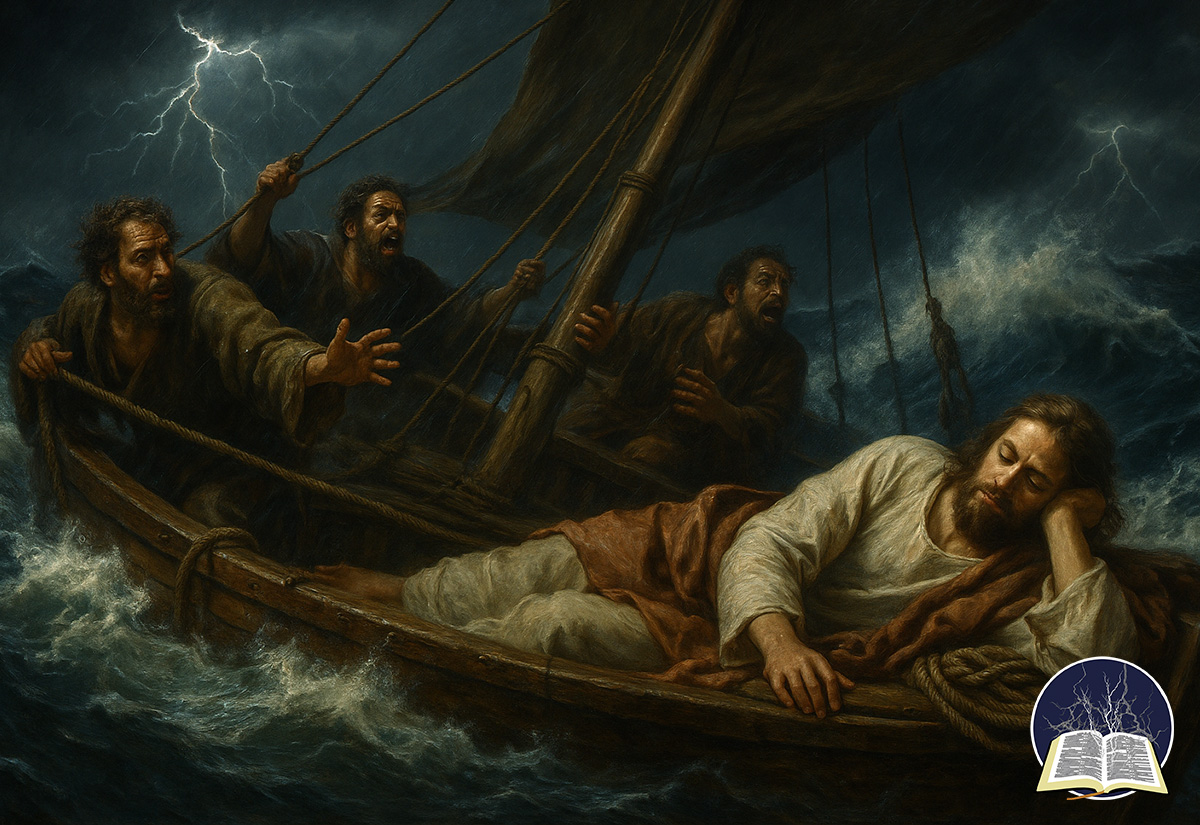
While a storm raged on the Sea of Galilee, Jesus was fast asleep in the boat (Mark 4:38). Can you imagine that? Thunder. Lightning. Wind that popped the sail, rocked the boat, and sent a wave splashing onboard. The disciples panicked, but still, Jesus slept. This shows that when he did sleep, he slept deeply—without carrying the turmoil of the day into the night.
What might that teach us? Jesus modeled a trust in the Father that allowed him to rest even when circumstances raged. Most of us carry our “storms” home from work—replaying conversations, stressing about deadlines, or imagining worst-case scenarios. True rest comes when, like Jesus, we learn to place our storms in God’s hands.
Wasted Hours
Entertainment has its place. Relaxing with a favorite show or book can bring joy. But many times, the extra episode, the endless scroll on our phones, or the movie we’ve already seen could be better spent in sleep.
Sleep provides healing for our whole being—body, emotion, and spirit. Medical studies confirm that the immune system functions best during sleep, and the body repairs itself most effectively when we rest.
God’s Rhythm of Renewal
From the beginning, God modeled rest. After six days of creation, he rested (Genesis 2:2–3). Did he need rest? No. He doesn’t slumber for sleep (Psalm 121:3–4). But he set a pattern for us. The Sabbath was for a life-giving rhythm, not a lifeless rule. Over time, people turned it into a rigid checklist—what could or could not be done. Jesus reminded the Pharisees that it wasn’t supposed to be that way (Mark 2:27).
Weekends today are filled with busyness—errands, events, endless activities. But Sabbath is about re-centering, not just ceasing. It’s a day to reconnect with God, restore relationships, and remember that we are not slaves to endless labor. Sabbath teaches us that we are human beings, not human doings.
Rest Versus Laziness
Our “body clock” signals when to wake and when to rest. But constant availability—being on call 24/7—disrupts that God-given rhythm. In those cases, sleep becomes irregular, shallow, or non-existent. That’s why fatigue often hits when the pressure lifts, like a balloon suddenly deflating.
It’s important to distinguish between rest and laziness. Rest follows purposeful work. Laziness avoids work altogether. Think of an athlete. Rest days are as crucial as training days. Muscles rebuild in rest. If an athlete trains nonstop, the body breaks down. Likewise, spiritual “muscles” grow when we balance diligent work with God-centered rest.
Rest as Preparation
Too often, we treat rest as a reward for work completed. But biblically, rest is also preparation for what’s ahead. A day of rest isn’t only for looking back. It equips us for the days ahead.
At its deepest level, rest is more than sleep or time off. True rest is found in God’s presence. Without him, even vacations can feel restless. With him, even brief pauses can be refreshing. This rest is not about inactivity but about peace of heart. It’s the kind of rest that allows us to work without being consumed by work. It’s the rest that sustains us through storms, keeps us healthy, and aligns us with God’s purpose.
Resting God’s Way
Rest is not optional. It’s God’s design. It protects health, enhances productivity, and deepens our spiritual walk. But it must be sought in God’s way, not through excuses or self-made rules.
When we allow God to direct, not only our work but also our rest, we shift from being self-directed to God-directed. In that balance, we discover not just the strength to labor but the peace to thrive.
Rest for the Weary Soul
When work piles up and the hours get long,
We push and push, but everything goes wrong.
Our brains get fuzzy. Our bodies say, “Stop.”
But we guzzle some coffee and try not to drop.
The truth is quite simple, though hard to confess,
More hours can wind up producing even less.
Like soil that must rest for the harvest to grow,
Our bodies need sleep, and they tell us so.
Remember when Jesus lay down in the boat.
The storm made it shake, but it still stayed afloat.
The disciples panicked. Their courage was gone,
But Jesus was snoozing, just sleeping along.
He trusted the Father, so calm he could be,
While thunder and lightning shook sky and sea.
If Jesus could rest in the middle of such strife,
Then maybe we can—in the storms of our life.
Some waste their best hours on movies and screens,
On chatter and noise, with TV reruns and familiar scenes.
But pillows and blankets can serve us much more,
By mending our health with strength to restore.
The Sabbath was offered as a gift from above,
A rhythm for resting, a pattern of God’s love—
Not rules to restrict us, nor chores to complete,
But time to recharge and to rest at his feet.
So take it from Solomon, wise in his own way.
There’s time for labor, and there’s time for play.
There’s time for our laughter and time for our sleep,
A promise from God that his rest we can keep.
For rest is not lazy. It’s holy and true,
Sharpening your mind for the work we must do.
Stop all the striving, the stress, and the test,
And learn from the Lord how to truly find rest.
Close your eyes and just lay down your head.
There’s no need for fear and no need for dread.
God watches over us, through our nights and days,
And gives us his rest in the most wonderful ways.
For many more open-ended discussion questions for almost every verse in the Bible, check out The Discussion Bible